
KnowledgeFlow AI PlatformGrounded Answers.
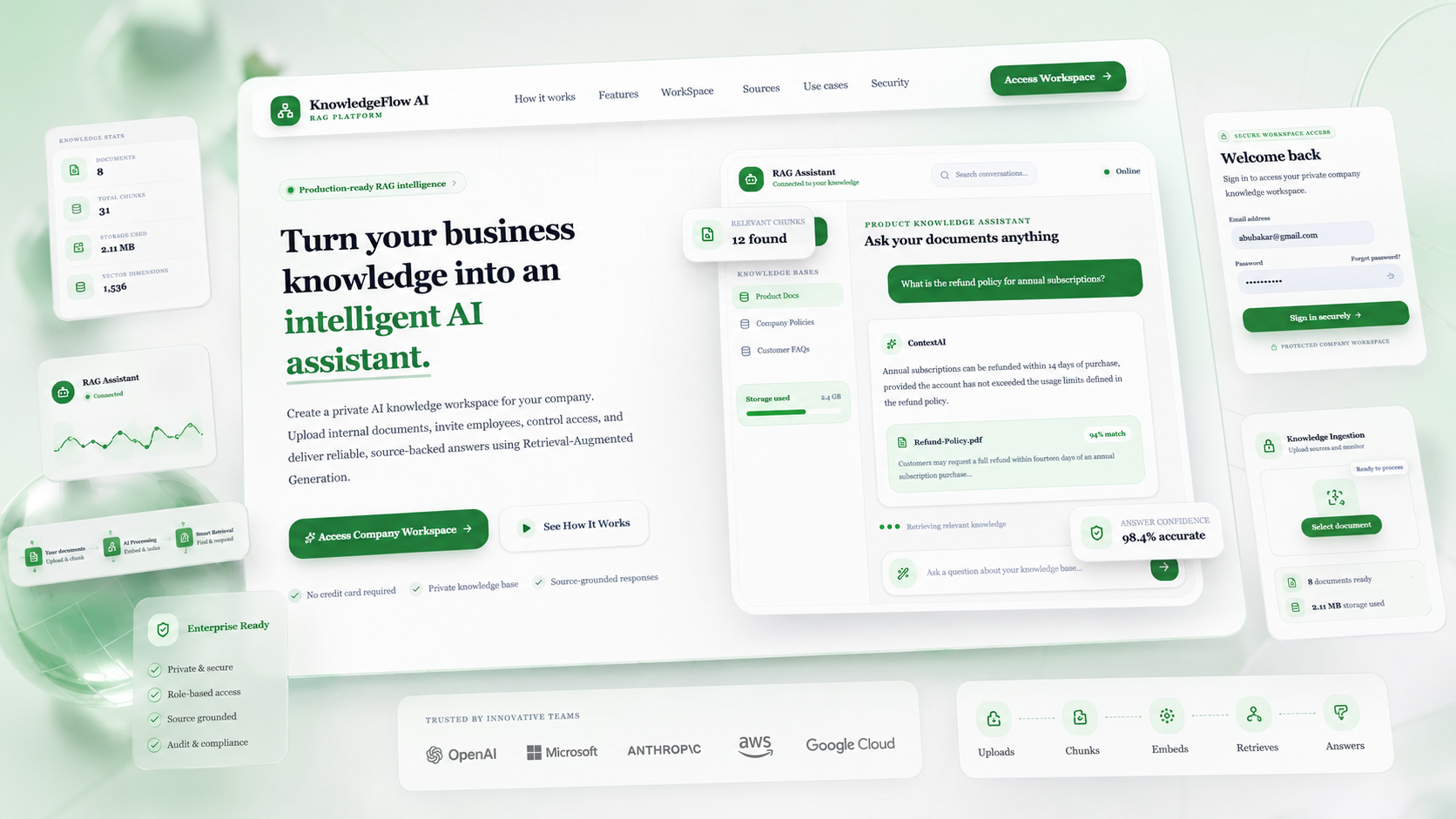
A production-grade private knowledge platform that transforms company documents into grounded, context-aware AI answers through controlled retrieval, structured processing and strict source usage.
Project Perspective
AI answers need evidence.
The challenge was not simply connecting a language model to uploaded documents. The system needed to understand private company knowledge, retrieve only the most relevant context and generate useful answers without drifting beyond the information the organization actually provided. KnowledgeFlow AI was designed around that requirement: retrieval first, grounded generation second and a clear system boundary around what the model is allowed to know.
Project Snapshot
Role
Full-Stack & AI Developer
Duration
6 Weeks
Year
2026
Core Stack
Next.js, Node.js, MongoDB, OpenAI, RAG, Cloudinary
KnowledgeFlow AI was built around a problem that becomes increasingly important as organizations adopt generative AI: a powerful language model is only useful when it can work with the information that actually belongs to the business.
Turning private documents into usable intelligence
The platform creates a controlled path from raw company documents to conversational knowledge. Uploaded files move through text extraction, chunking and embedding generation before their content becomes available to the retrieval layer. Instead of placing entire documents into a prompt, the system searches for the portions of knowledge most relevant to each question.
This changes the role of the language model. It is not expected to independently know the answer. Its responsibility is to reason over the context supplied by the retrieval system and transform that evidence into a clear, useful response.
Reliable AI begins when the system knows what information the model should use, what it should ignore and where its answer is coming from.
RAG as a system, not a feature
The retrieval pipeline was treated as core application architecture rather than a small feature attached to a chat interface. Documents are processed into manageable knowledge units, embeddings represent their semantic meaning and similarity-based retrieval selects context according to the user's question.
This separation between knowledge storage, retrieval and generation creates more control over the final response while also making the system easier to debug, evaluate and improve.
Designed around controlled knowledge
KnowledgeFlow AI also considers the operational side of private AI systems. Documents belong to an organizational knowledge base, administrative controls define how the system behaves and users interact with information through permissions rather than unrestricted access to everything stored in the application.
The result is a foundation that can support more than document chat. The same architecture can evolve toward department-level knowledge spaces, advanced retrieval strategies, source visibility, evaluation pipelines, analytics, automated workflows and agentic systems that operate on trusted company context.
Engineering beyond the interface
The visible chat experience is only the final layer. Behind it sits a pipeline responsible for document handling, knowledge transformation, embeddings, retrieval, contextual generation and application-level access. Building these responsibilities as connected but separate components was essential to making the product maintainable beyond its first release.
Product Principles
4 decisions shaped the experience.
01
Grounding before generation
The model receives carefully retrieved company context before answering, reducing unsupported responses and keeping conversations aligned with the organization's actual knowledge.
02
Retrieval with purpose
Documents are processed into structured chunks and embeddings so the system can search semantic meaning instead of relying on simple keyword matching.
03
Control over convenience
Permissions, source boundaries and retrieval behavior are treated as product requirements rather than secondary implementation details.
04
Systems over demos
The platform was engineered as a reusable product with document processing, retrieval, chat, administration and access control working as one connected system.
System Thinking
Built as InfrastructureNot Features
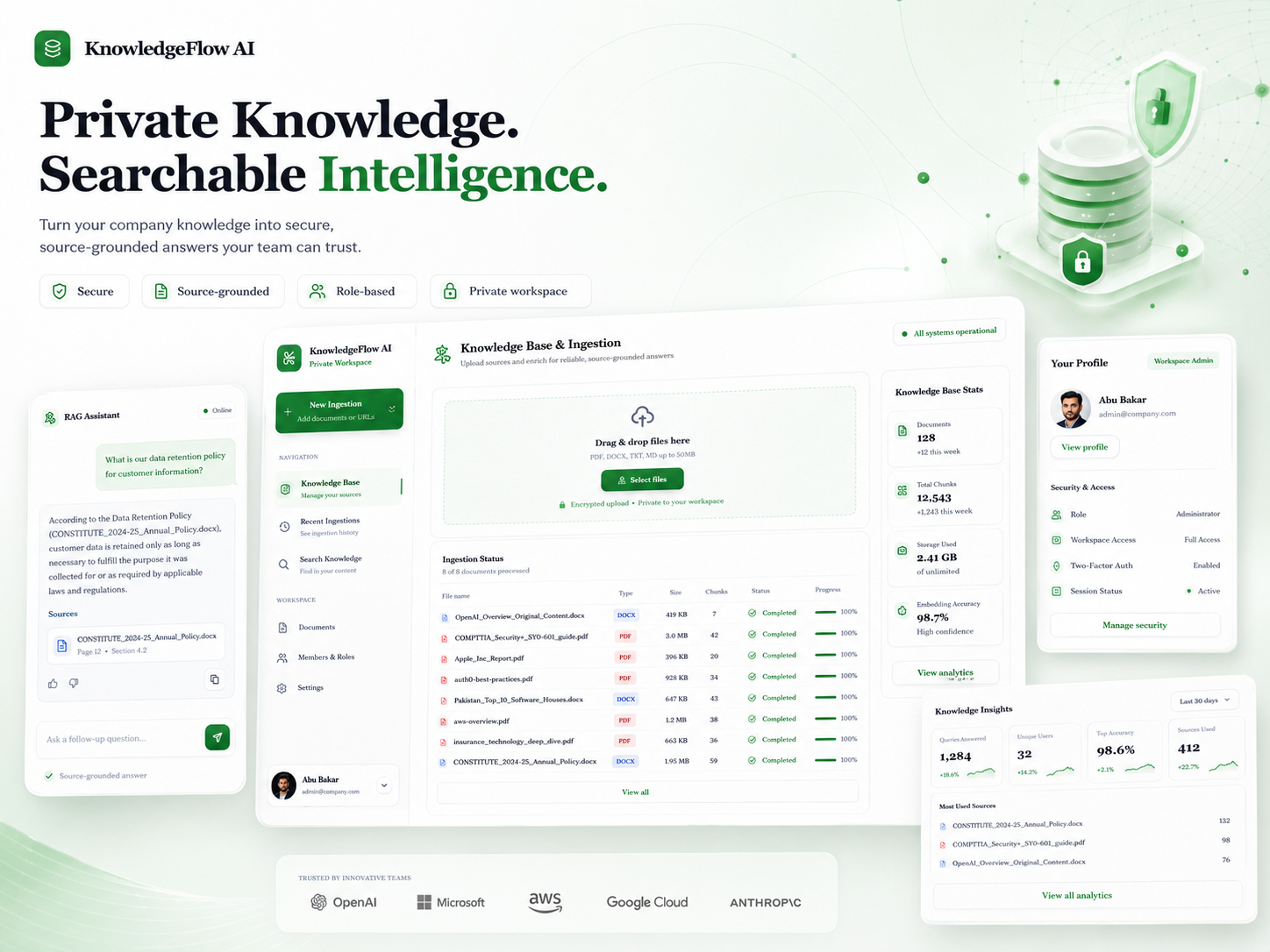
The system was designed as a complete knowledge pipeline where ingestion, chunking, embeddings, retrieval, permissions, chat, and administration work together as one scalable, secure AI workspace.
Private company documents transformed into searchable AI knowledge
Context-grounded responses generated from retrieved company information
Reusable document ingestion and embedding pipeline
Structured separation between retrieval and answer generation
Role-based foundation for controlled organizational knowledge access
Architecture prepared for evaluation, analytics and future AI workflows
Final Outcome
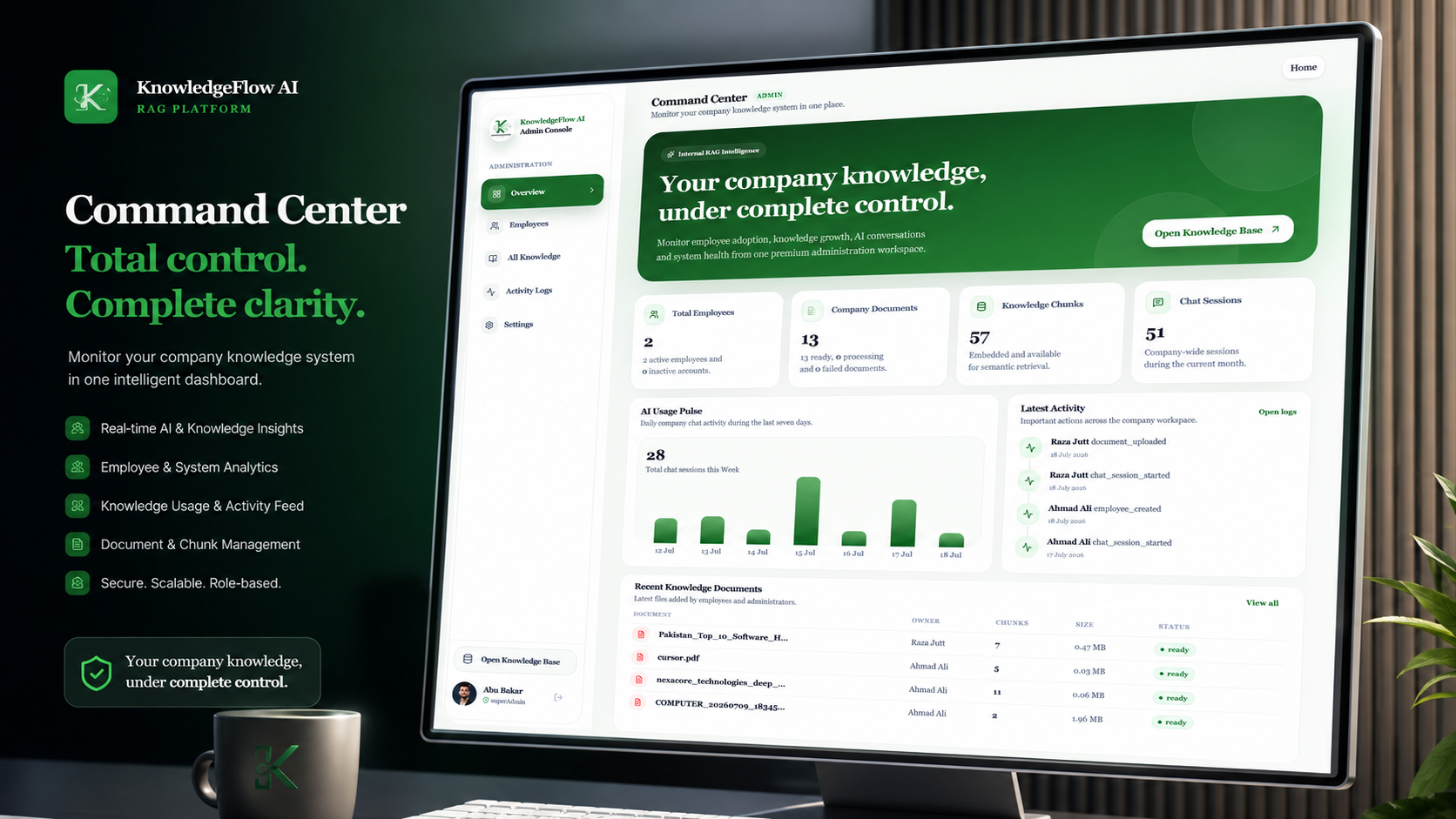
Knowledge becomes operational intelligence.With Trust.
KnowledgeFlow AI turns static internal documents into an accessible AI knowledge layer while preserving the retrieval boundaries, source control and system structure required for serious production use.
Start something similar
Want a similarplatform, website or service?
If you have an idea, an existing product that needs improving, or a platform worth building properly, tell me what you are working on.
Next Project