
Desk AI — Multi-Agent Research WriterAgentic Research
Desk AI is a source-aware multi-agent research and writing platform built to turn a single topic into a structured, reviewed, SEO-ready article. Instead of relying on one model to handle the entire task, the product coordinates specialized agents for research, writing, verification, refinement, and publishing preparation, giving the workflow the discipline of a small editorial desk rather than a conventional AI text generator.
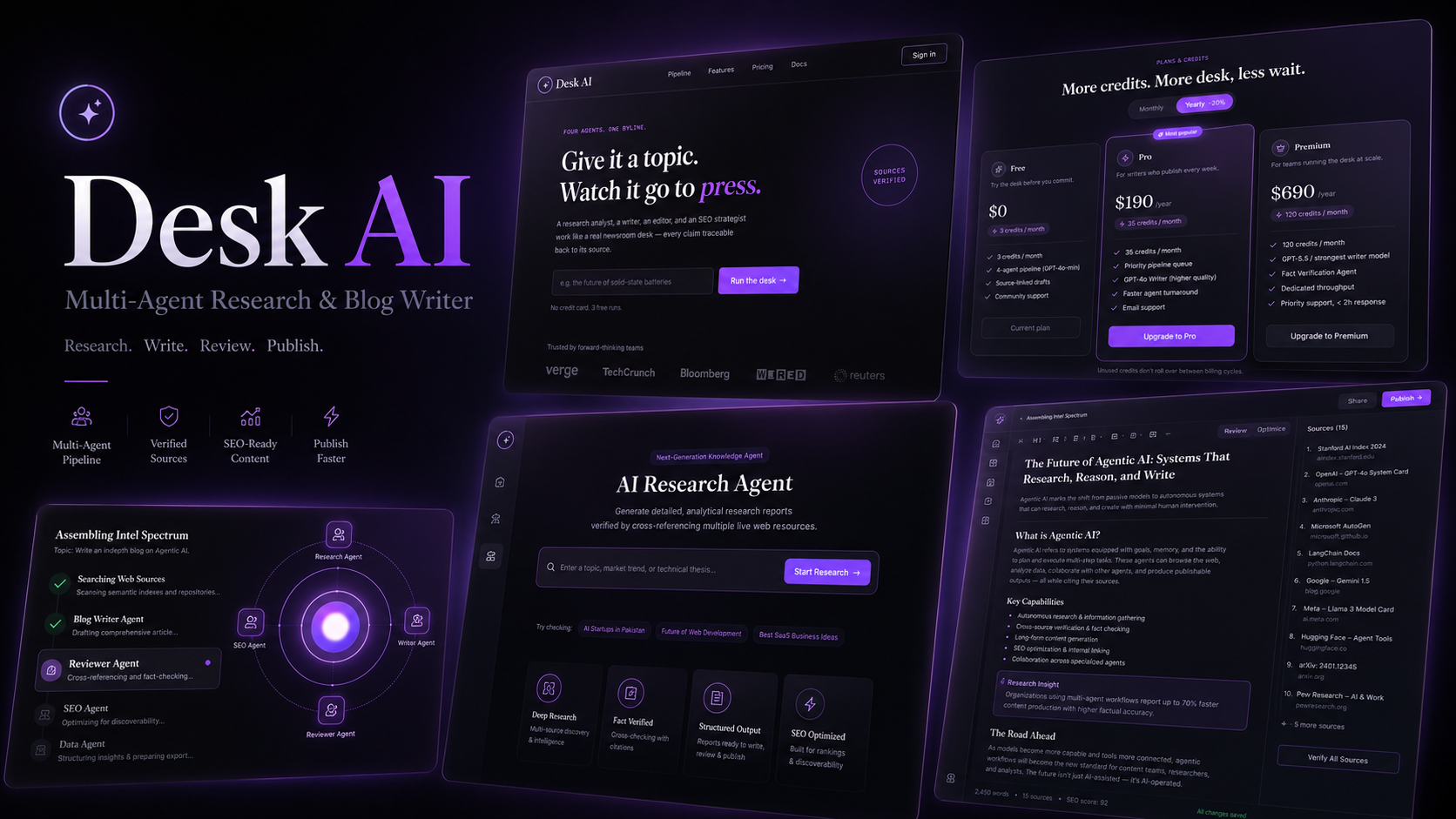
Project Perspective
Building an AI writer was not the difficult part. Building one I could actually trust was. Editorial Trust
Most AI writing products are optimized around a simple interaction: enter a prompt, wait for a response, and edit whatever comes back. That approach works for lightweight generation, but it begins to fall apart when the output needs research depth, traceable sources, factual consistency, editorial structure, and a clear path toward publication.
I wanted Desk AI to feel less like another chat interface and more like a working editorial desk. A topic should move through distinct stages, with each stage having a specific responsibility and visible progress. Research should happen before writing, claims should be challenged before approval, and SEO should improve a finished argument rather than dictate it from the beginning.
That perspective shaped both the underlying agent workflow and the product interface. The goal was not to hide complexity behind a loading spinner, but to make the intelligence of the system understandable while keeping the experience simple for the person using it.
Project Snapshot
Role
Full-Stack & Agentic AI Developer
Duration
4–6 Weeks
Year
2026
Core Stack
Next.js 16, React, Tailwind CSS, Framer Motion, Node.js, Express.js, MongoDB, OpenAI API, Server-Sent Events
From prompt generation to an editorial workflow
Desk AI started from a straightforward question: what would an AI writing product look like if the system was designed around the way good editorial work actually happens?
A normal text-generation flow puts an enormous amount of responsibility on one model invocation. It has to understand the topic, find the right angle, remember relevant facts, structure the argument, write convincingly, avoid unsupported claims, optimize the article, and somehow evaluate the quality of its own result. Even when the output reads well, the process gives the user very little visibility into where the information came from or how much confidence they should place in it.
Desk AI takes a different approach. Research, writing, review, verification, and optimization are treated as separate responsibilities inside one coordinated system. The user still begins with a simple topic, but behind that interaction the request moves through a sequence of specialized agents.
The research stage
The first responsibility is not writing. It is understanding what needs to be researched and gathering enough useful context for the next stage to work with. The research layer searches for relevant information, organizes useful findings, and prepares a stronger knowledge foundation before the article is drafted. This separation matters because the quality of long-form writing is heavily influenced by the quality of the context available before generation begins.
The writer is part of the pipeline, not the entire product
Once research context is available, the writer agent transforms it into a coherent article. Its responsibility is narrative structure, explanation, readability, and long-form continuity. It does not need to behave as the researcher, reviewer, and SEO specialist at the same time. Giving the writer a narrower responsibility produces a cleaner workflow and makes later evaluation much more meaningful.
Review happens after generation
One of the most important decisions in the project was introducing an explicit reviewer stage. The draft is treated as something that still needs to earn its final state. The reviewer examines the written output, looks for weak claims, checks whether important statements are supported, and identifies areas where the content can be clearer or more credible. That separation creates a useful tension inside the system: the component producing the draft is not the only component judging whether that draft is good enough.
Source visibility is part of the interface
I did not want verification to exist only as invisible backend logic. The product interface keeps source information close to the article so users can understand why a claim should be trusted. The editor and research views are therefore designed around two parallel ideas: the content itself and the evidence supporting it. Sources, credibility indicators, verification states, and research context become part of the working experience instead of metadata hidden after generation.
SEO comes after the argument
The SEO agent works near the end of the pipeline. By that point, the system already has a researched, written, and reviewed article. SEO can then improve headings, metadata, keyword placement, discoverability, and publishing readiness without forcing the entire article to be written around optimization signals from the beginning. This keeps the editorial quality of the piece ahead of mechanical keyword usage.
Making long-running AI work feel responsive
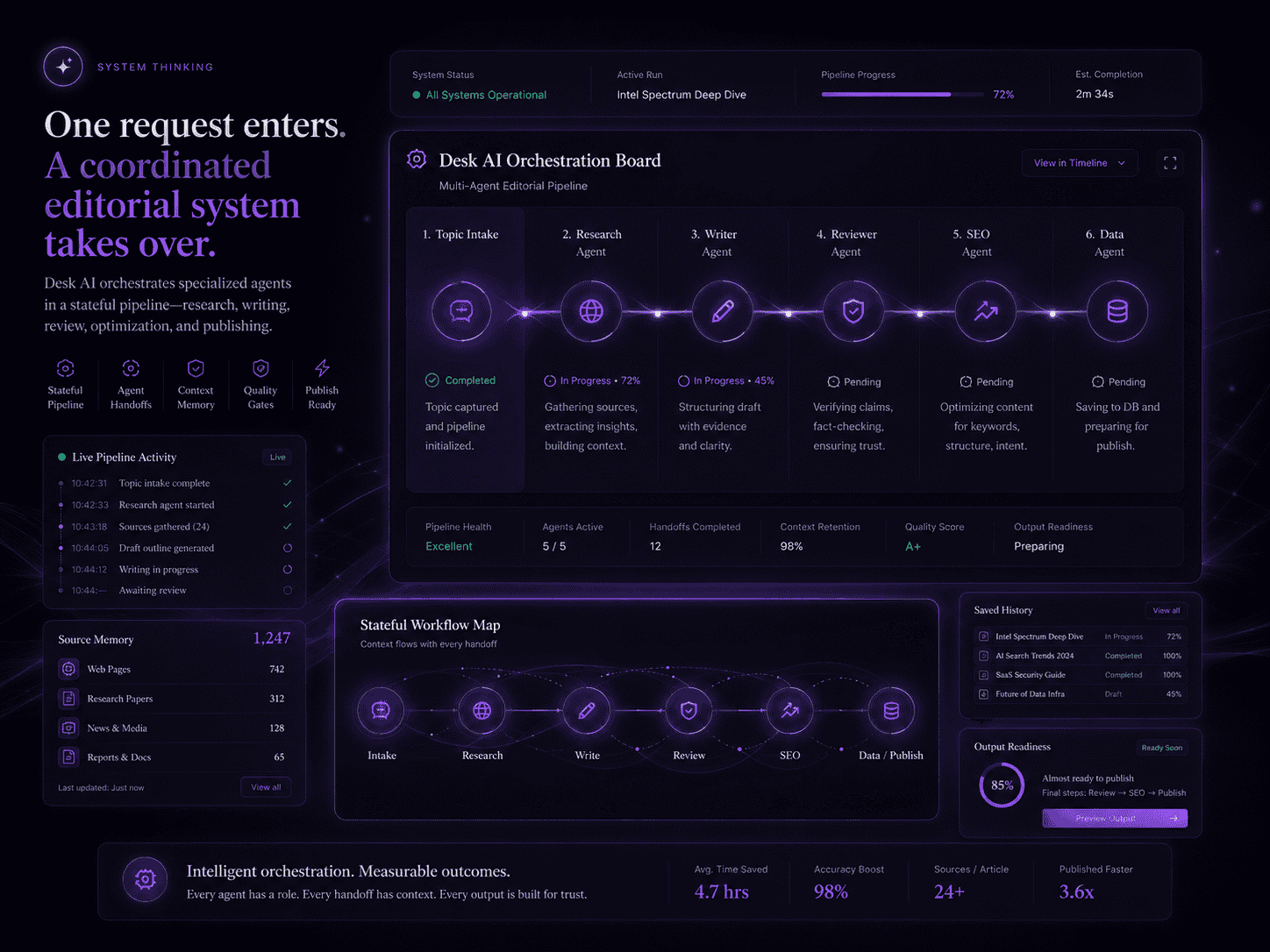
Multi-agent workflows introduce a product challenge that does not exist in a basic chatbot: meaningful work can take time. Instead of displaying a spinner while several operations happen in the background, Desk AI exposes progress through an agent activity interface. Users can see when research is running, when a draft is being prepared, when the reviewer becomes active, and when later stages are waiting for their turn. Server-Sent Events are used to deliver live progress updates so the experience feels active without requiring constant page refreshes or artificial progress animations.
Designed as a SaaS product, not a technical demo
The project goes beyond the pipeline itself. Research history, report views, saved outputs, pricing states, credit-based usage, responsive navigation, article editing, sources, and reusable workflow components were designed as parts of the same product system. The visual direction combines an editorial serif style with a restrained purple interface language, giving the platform its own identity while keeping complex AI behavior understandable.
The result is a product where the intelligence is not limited to the final paragraph generated on screen. The value is in the sequence of decisions that happen before that paragraph becomes publishable: gathering evidence, passing context between agents, reviewing the draft, verifying important claims, improving structure, and showing the user enough of that process to build confidence in the final work.
Product Principles
4 decisions shaped the experience.
01
Specialists Over Generalists
Each stage is handled as a focused responsibility rather than asking one model to research, write, verify, optimize, and judge its own work in a single pass.
02
Sources Before Confidence
A polished paragraph is not treated as trustworthy by default. Research context and source-backed claims remain part of the workflow so the final article has evidence behind its strongest statements.
03
Visible Agent Progress
Long-running AI work should not feel like a black box. The interface communicates which agent is active, what has already completed, and what still needs to happen.
04
Editorial Quality First
SEO, structure, readability, and optimization support the article instead of replacing good research and useful writing. The system is designed around publishable quality rather than raw generation volume.
System Thinking
One request enters. A coordinated editorial system takes over.Agent Orchestration
Desk AI treats article generation as a stateful pipeline. A research request first establishes the topic and gathers useful source material. That context moves into the writer, where it becomes a structured long-form draft. The reviewer then works against the draft instead of blindly extending it, checking claims, source alignment, clarity, and weak reasoning. Once the content is reliable, the SEO stage improves discoverability, metadata, structure, and publishing readiness. Progress is streamed back to the interface so the user can see the system moving through each handoff. Research history, generated reports, sources, agent state, and final content are persisted so the experience behaves like a product workspace rather than a temporary AI conversation.
Converted a single research topic into a structured multi-stage workflow covering research, drafting, review, source validation, SEO refinement, and final output.
Designed a live agent-progress experience that makes long-running AI operations understandable instead of hiding the process behind a generic loading state.
Created a source-oriented article workspace where generated research, citations, editorial content, and verification context remain visible together.
Built the product as a complete SaaS experience with research history, article workflows, premium plans, usage credits, responsive interfaces, and reusable application states.
Established a visual system that gives technical AI workflows a premium editorial identity without making the interface feel like a developer dashboard.
Final Outcome
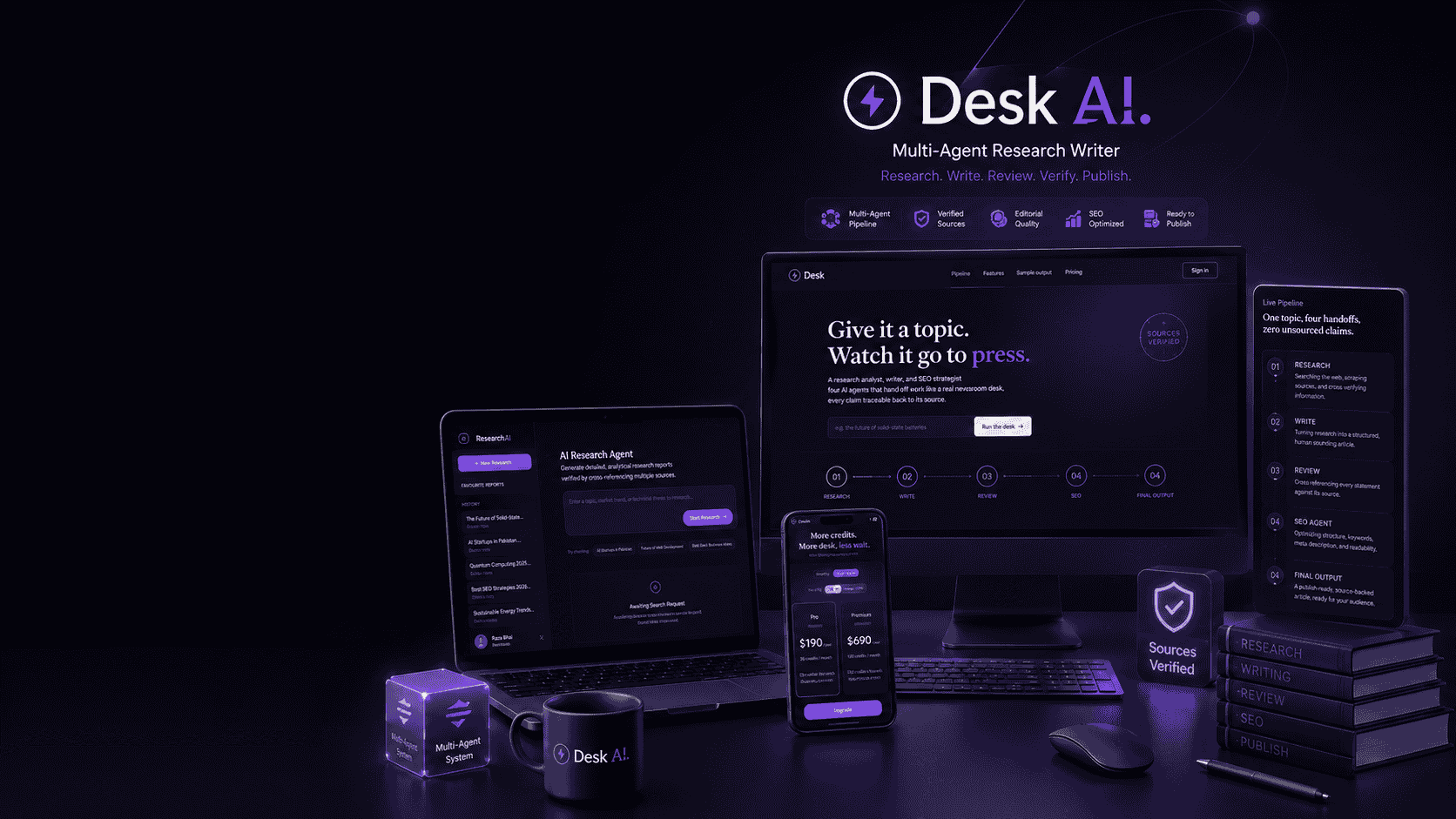
A research product that feels like a desk, not a prompt box.Production Ready
The final product combines a multi-agent backend with an editorially focused SaaS interface that makes complex AI work feel structured and understandable. A user can begin with one research topic, follow the work as specialized agents move through the pipeline, review a long-form source-backed article, inspect supporting references, and reach a polished output prepared for publishing. The strongest outcome is not simply that Desk AI can generate content. It is that the product creates a visible process around that generation, giving research, verification, editing, and optimization their own place in the experience.
Start something similar
Want a similarplatform, website or service?
If you have an idea, an existing product that needs improving, or a platform worth building properly, tell me what you are working on.
Next Project