
Prowebier AI — Intelligent SaaS WorkspaceIntelligence Crafted
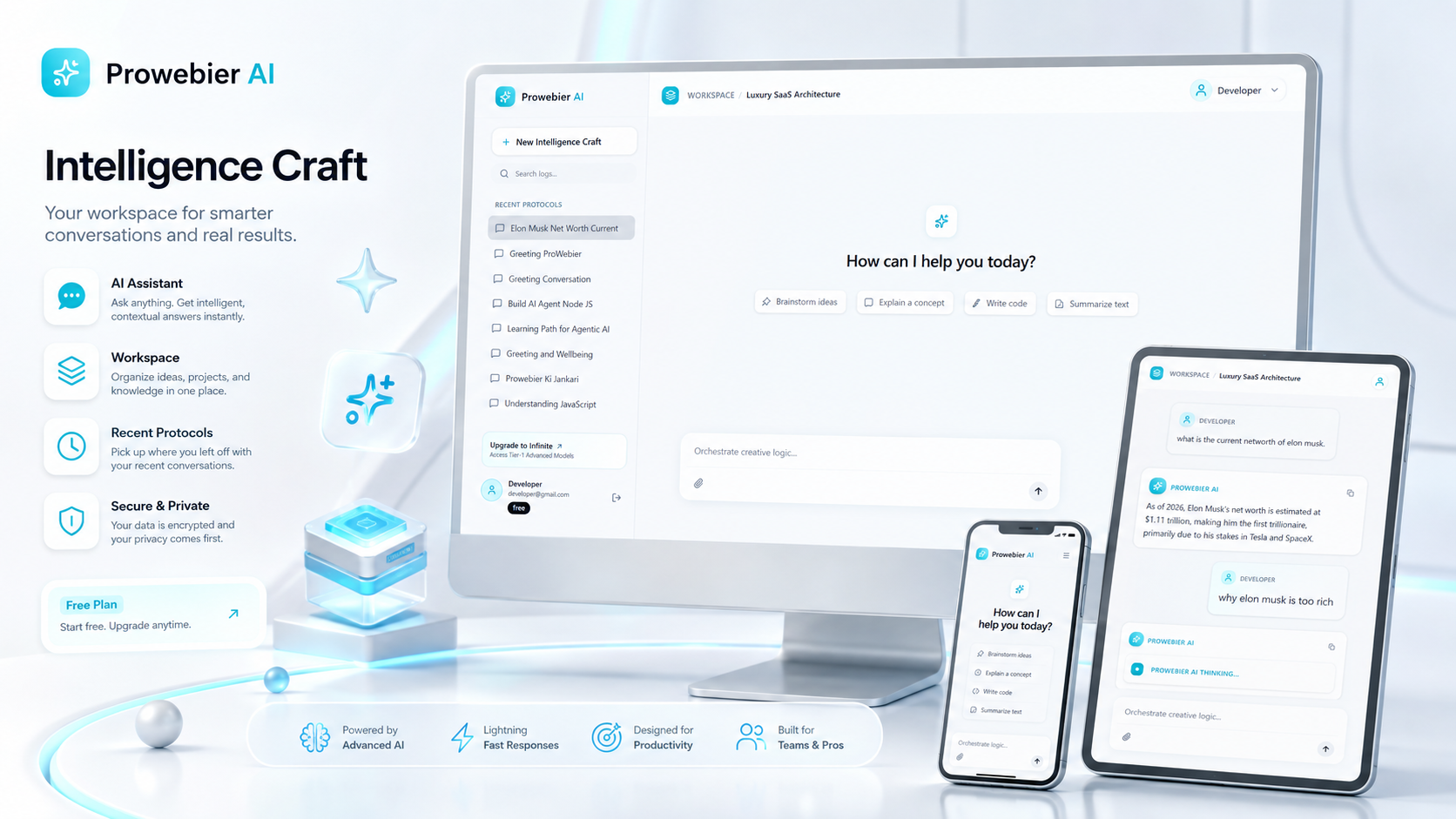
Prowebier AI is a production-focused AI SaaS workspace built around thoughtful conversations, multimodal input, real-time streaming, practical tools, persistent work history, and subscription-based usage. The experience brings AI interaction, account management, billing, credits, saved conversations, and everyday productivity into one polished product rather than treating intelligence as a standalone prompt box.
Project Perspective
The product needed to feel useful before it felt intelligent. Product Utility
The interesting part of building Prowebier AI was never simply getting text back from a model. That was only one layer of the product. The bigger challenge was turning AI interaction into something people could return to, understand, manage, and eventually pay for.
Conversations needed to persist. Responses needed to appear naturally instead of arriving after an awkward wait. Different plans needed clear limits. Images had to become part of the input experience without making the composer complicated. Billing, credits, account state, history, tools, and model usage all had to work around the conversation instead of competing with it.
I approached the interface as a working environment rather than a demo screen: somewhere a user can start an intelligence craft, continue an earlier thread, bring visual context into a request, use purpose-built tools when needed, understand their remaining access, and manage their subscription without leaving the product. That shift from model integration to product infrastructure is what shaped the final experience.
Project Snapshot
Role
Full-Stack & AI Developer
Duration
6+ Weeks
Year
2026
Core Stack
Next.js 16, React, Tailwind CSS, Framer Motion, Node.js, Express.js, MongoDB, OpenAI API, Server-Sent Events, Stripe
Building the product around intelligence, not around a prompt box
Prowebier AI started with model interaction, but it quickly evolved into a much broader product engineering challenge. Generating an answer is relatively straightforward. Building a complete experience where that answer belongs to a conversation, respects a user's subscription, consumes the correct usage allowance, accepts visual context, streams naturally into the interface, remains accessible later, and behaves consistently across devices is a very different problem.
The goal was to make the product feel like a focused intelligence workspace rather than a simple response generator. A user should be able to arrive, begin something new, continue previous work, attach context, choose how they want to interact, and remain inside the same environment from the first request through account and billing management.
A persistent workspace instead of disposable sessions
Conversation history became an important architectural decision early in the project. Each conversation is treated as its own piece of work rather than a temporary collection of messages stored only in the browser.
Conversation metadata and individual messages are stored separately. This keeps the sidebar lightweight and efficient while allowing the complete message history of a selected conversation to be loaded only when it is needed.
This approach also changes how the product feels to use. Recent conversations in the sidebar are not decorative history. They function as a real working archive.
A technical discussion, strategy session, research question, previous draft, or ongoing task can be reopened and continued instead of being recreated from memory.
Real-time output with Server-Sent Events
AI interfaces quickly become frustrating when nothing appears to be happening between submitting a request and receiving the final result.
For Prowebier AI, the response lifecycle was designed around progressive delivery using Server-Sent Events. Instead of waiting for the entire model response to finish on the server, generated content is streamed into the interface as soon as it becomes available.
The frontend can therefore move immediately from user input into an active generation state, update the current response progressively, and persist the completed result once streaming has finished.
This gives longer responses a much more natural rhythm and makes the product feel responsive without relying on artificial loading timers or simulated progress.
Text and visual context belong in one composer
The input experience was intentionally kept familiar, but its responsibility extends beyond plain text.
Users can combine written instructions with image input whenever visual context is relevant. The important design decision was not to turn multimodal interaction into a completely separate workflow.
Attachments belong beside the user's request. Adding an image should feel like expanding the context of an existing conversation rather than moving into another section of the application.
The composer also acts as the gateway to additional tools. These capabilities remain available when they add value, but they do not dominate the interface.
The default experience remains simple enough for a straightforward request while still providing room for more capable workflows when a task requires them.
Thinking states that communicate progress
Streaming solves much of the waiting problem, but there are still moments where preparation happens before meaningful output becomes available.
Instead of leaving the user with an empty response container, Prowebier AI exposes an intentional processing state that communicates that work is actively taking place.
It is a relatively small interaction, but it makes the transition between request and response feel much more deliberate and polished.
Credits as part of the product model
Usage is not treated as an invisible backend counter.
Free and paid plans have clearly defined allowances, and the application understands which capabilities and consumption rules belong to each subscription tier.
This allows access decisions to happen before expensive work begins instead of discovering after generation that a request should not have been allowed.
Credit information can also be surfaced throughout the product wherever it becomes useful, including the current plan, billing interface, upgrade flow, and account controls.
This gives users a much clearer relationship between what they are consuming and what their plan actually provides.
Stripe integrated into the application lifecycle
Stripe is integrated directly into the subscription lifecycle of the product rather than being treated as an isolated checkout page.
The billing experience reflects the user's current plan and provides a natural path from free usage into a paid subscription.
Once a subscription changes, that state can influence product access, available credits, and entitlement decisions throughout the application.
From a product perspective, this matters because the upgrade button, checkout process, subscription status, and actual feature access all need to represent the same reality.
A paid plan only creates value when the rest of the application reliably understands what the user has paid for and adjusts access accordingly.
Account and billing without leaving the workspace
Account management is handled through a focused settings experience rather than sending users through multiple disconnected pages.
Personal information, current plan, usage, subscription details, billing information, and upgrade actions remain inside a consistent modal-based environment.
The background workspace is softened while settings take focus, preserving the user's context without creating a hard break from the product.
This became especially important once credits and subscriptions were introduced.
Users need one clear place where they can answer straightforward questions such as which plan they are currently using, how much of their allowance remains, and what would change if they upgraded.
One product across desktop, tablet, and mobile
The workspace was also designed to remain useful beyond a large desktop canvas.
Desktop layouts provide enough room for conversation history and active work to exist together, while tablet and mobile layouts preserve the essential hierarchy without forcing every desktop panel onto a smaller screen. The goal was never strict visual parity at every breakpoint. The goal was functional continuity. A conversation started on one device should still feel familiar when continued on another, with the same core actions, interaction patterns, visual language, and product identity.
A foundation designed to grow
One of the strongest engineering outcomes of Prowebier AI is that its most valuable systems are not tied to one isolated interface.
Streaming, conversation persistence, multimodal requests, tools, credits, subscriptions, authentication, settings, billing state, and responsive workspace behavior all contribute to a reusable product foundation.
That gives the platform room to evolve without changing the fundamental relationship between the user and the workspace.
New tools can be introduced through the same composer. Different models can operate behind the same interaction pattern. Paid tiers can expose different entitlements without requiring separate applications. Usage rules can evolve without rewriting the entire conversation experience. Additional product capabilities can be introduced without rebuilding the underlying structure from scratch.
Product Principles
6 decisions shaped the experience.
01
Conversation With Continuity
Useful AI work rarely ends after one request. Conversations are persisted so users can revisit previous work, continue context, and treat earlier outputs as part of an ongoing workspace.
02
Streaming Over Waiting
Responses are delivered progressively through Server-Sent Events, giving users immediate feedback while longer generations continue instead of making the interface feel blocked.
03
Multimodal By Design
The composer supports more than plain text. Images can be included alongside written instructions, allowing visual context to become part of the same natural request flow.
04
Usage With Clarity
Free and paid access is tied to visible usage rules and credits, so the commercial model feels understandable inside the product rather than appearing only at checkout.
05
Tools When Useful
Purpose-built tools extend the core intelligence experience without turning the interface into a technical control panel. The user remains focused on the outcome, not the plumbing behind it.
06
SaaS Beyond Generation
Authentication, history, subscriptions, usage state, account settings, billing and responsive behavior were treated as first-class product concerns, not secondary screens added after the AI experience.
System Thinking
A conversation is only one part of the system.SaaS Architecture
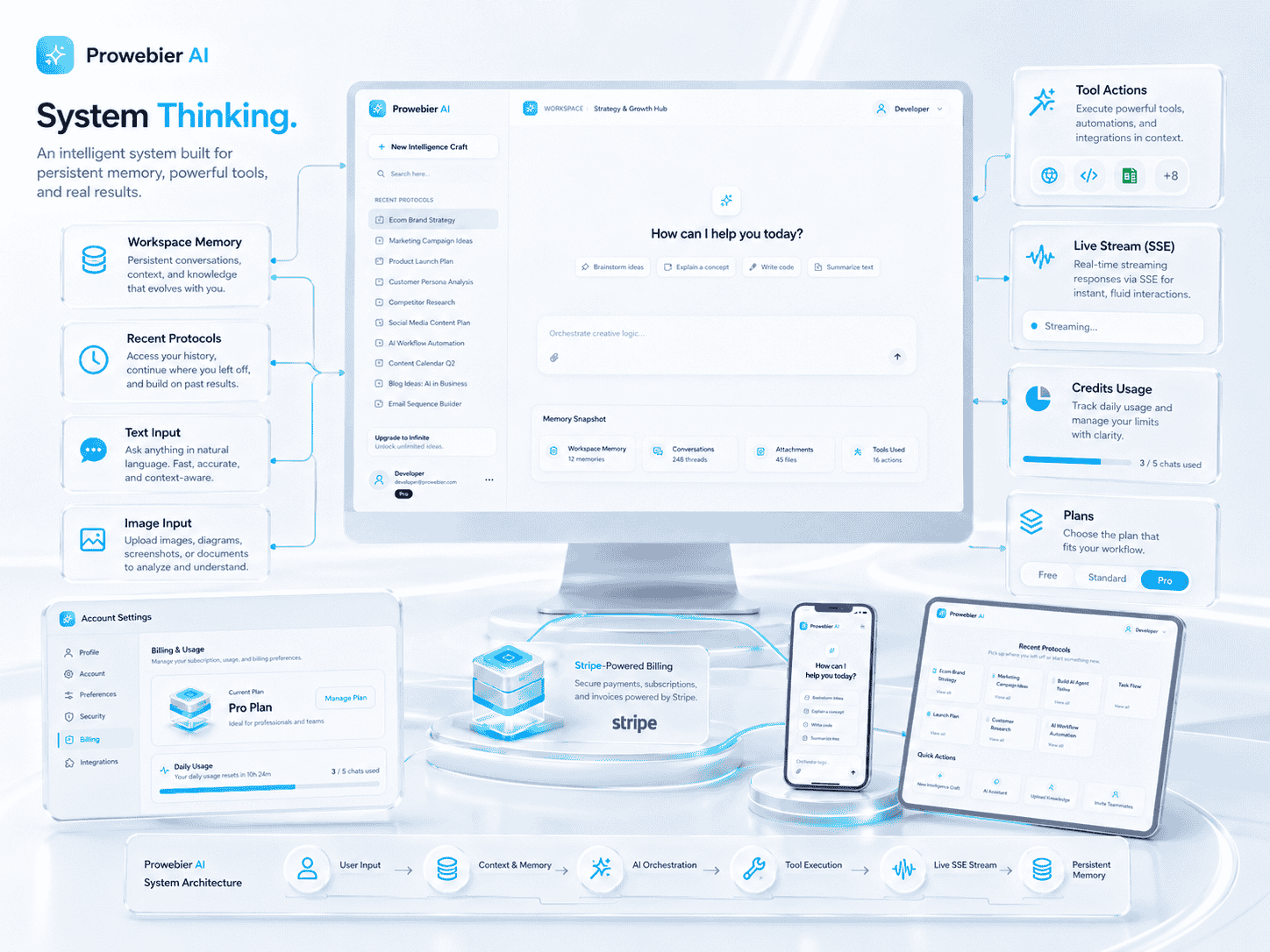
Prowebier AI is structured around a connected product lifecycle rather than a single request-response endpoint. A user begins inside a persistent workspace where previous conversations can be searched and resumed. New requests can carry text or image context, while tool-enabled actions extend what the interaction can accomplish. Once a request is submitted, the backend prepares the appropriate context, coordinates model execution, and streams the result back through SSE so the interface can render progress as the response is produced. Conversation and message records are persisted independently, allowing history to remain lightweight while individual threads retain their structure. Around that intelligence layer sits the SaaS infrastructure: plan entitlements, credit consumption, usage limits, Stripe-powered subscriptions, account information, billing controls, and upgrade paths. Each layer has a separate responsibility, but they meet inside one workspace so the experience remains simple from the user's perspective.
Built a complete AI SaaS workflow that connects conversation intelligence with subscriptions, account management, persistent history, usage controls, and product-level billing.
Implemented Server-Sent Events for progressive response delivery, creating a faster and more natural experience during longer generations.
Introduced text and image-based input within the same composer so users can provide both written instructions and visual context without switching workflows.
Created persistent conversation and message storage that allows users to reopen previous work and continue from earlier context instead of starting over.
Integrated Stripe into the product lifecycle for paid subscriptions, upgrades, billing management, and plan-aware access.
Designed free and paid usage around credits and entitlement rules, making consumption visible and enforceable at the application level.
Added tool-enabled interactions that expand what users can accomplish while keeping the primary interface focused and approachable.
Created responsive desktop, tablet, and mobile experiences around the same workspace architecture instead of reducing smaller screens to simplified afterthoughts.
Built dedicated account and billing surfaces so subscription state, usage, plan information, and personal settings remain understandable without leaving the product.
Established a reusable SaaS foundation that can support additional models, tools, plan tiers, and intelligence features without redesigning the core experience.
Final Outcome
Intelligence became a product, not just a response.Complete SaaS
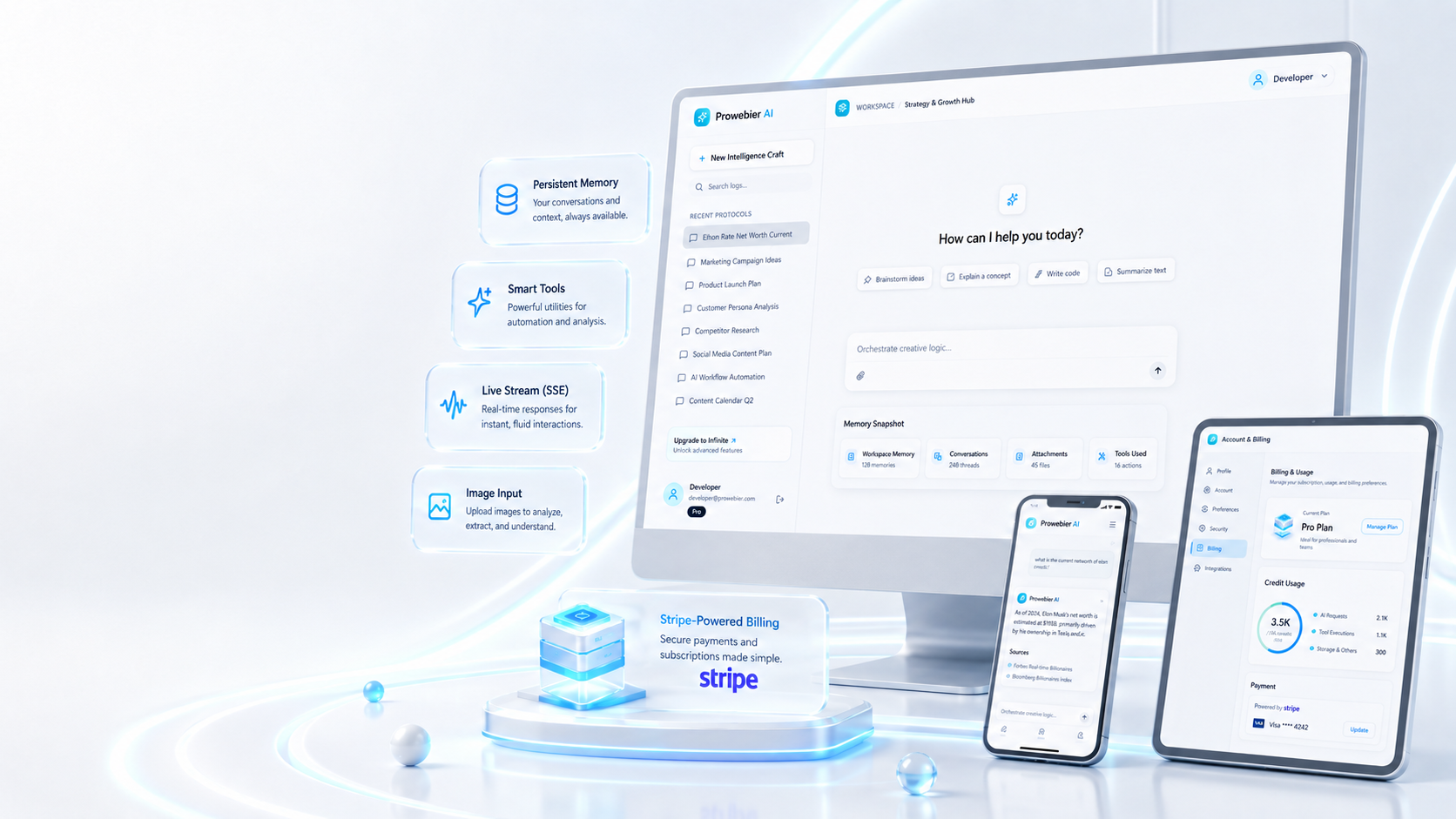
The finished experience brings together real-time AI interaction, text and image input, tool-assisted workflows, conversation history, usage credits, free and paid access, Stripe subscriptions, account controls, responsive layouts, and persistent data within one polished workspace. Prowebier AI demonstrates the difference between connecting a model to an interface and engineering a complete SaaS product around that capability. Users are given continuity, visibility, control, and a clear relationship between the intelligence they use and the plan that supports it.
Start something similar
Want a similarplatform, website or service?
If you have an idea, an existing product that needs improving, or a platform worth building properly, tell me what you are working on.
Next Project